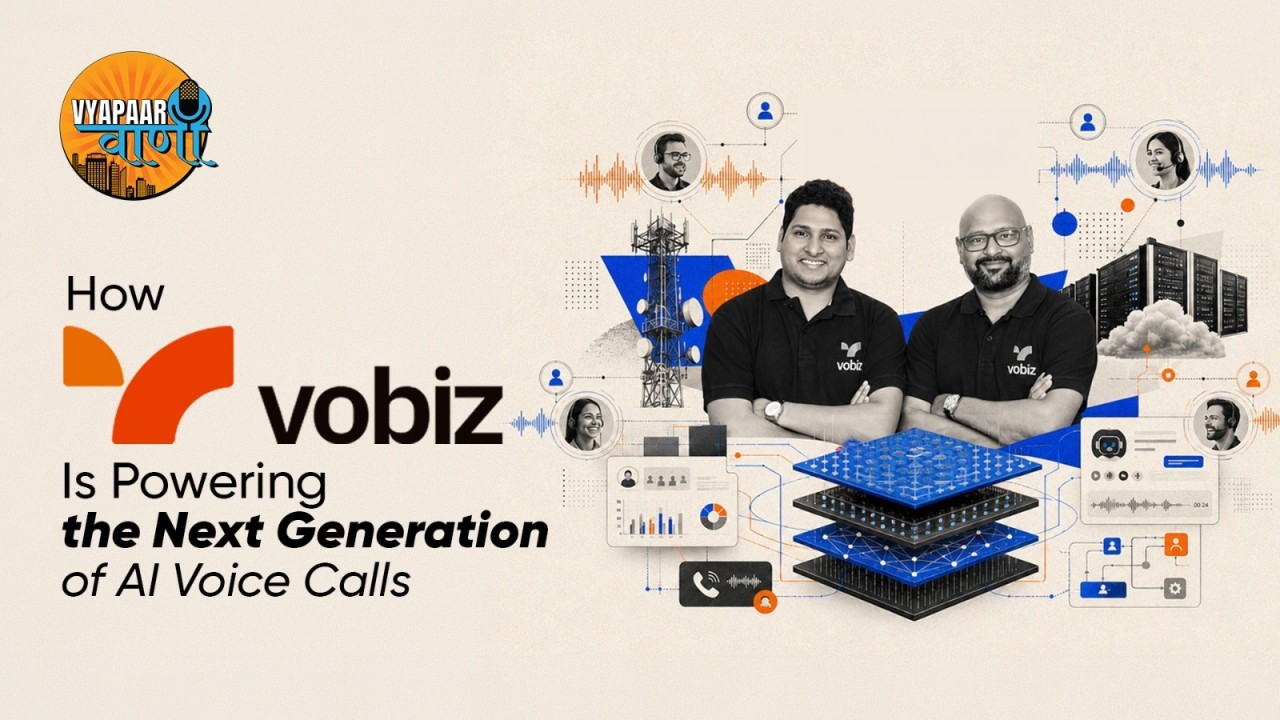
How Vobiz.ai Is Powering the Next Generation
of AI Voice Calls
This Week's Highlights

5 Top Manufacturing Startups To Watch

How Flo Mobility Is Bringing AI-Powered Robots to India's Construction Sites

Bad Skin Day Billion Dollar Idea: The Yes Madam Story

How Frostreats Turned A Simple Idea Into ₹14 Crore Business

Secures ₹290 Crore Series B To Scale Rural Retail Network

How Pilgrim Achieved 24x Growth In The Beauty Industry?
Voice AI is having its moment. Enterprise pilots are multiplying. Automated calling systems are handling customer support, collections, and sales at scale. The demos are impressive and the investment is flowing.
But beneath all of it lies a problem nobody is talking about loudly enough. Every AI voice call still depends on telecom infrastructure that was designed for human conversations, not machine-scale conversational AI. Latency, routing, spam detection, and call completion were all built for a different era. And the mismatch is becoming a serious bottleneck for anyone trying to deploy voice AI at production scale.
Bengaluru-based Vobiz.ai was built to solve exactly that.
The Problem That Started It All
Before founding Vobiz.ai, Gandham had already built and exited a startup. His consumer neobank Finin was acquired by Open, after which he took a sabbatical before returning to build AI voice agents for financial services use cases.
It was during that work that the infrastructure problem became impossible to ignore. He partnered with Srivastava, who had spent years inside telecom infrastructure companies including Plivo and Bandwidth, and together they began rebuilding the telecom layer specifically for AI-native communication systems.
The core issue is deceptively simple. Traditional telecom infrastructure introduces 300 to 500 milliseconds of delay on its own. When you stack speech-to-text processing, large language model inference, and text-to-speech generation on top of that, total response time can easily exceed 1.5 seconds.
At that threshold, the experience breaks down.
"At that point, humans immediately recognise they are speaking with AI," Srivastava explains.
There is also a reliability problem that does not exist in human calls. In a normal conversation, if audio cuts for two seconds, you simply ask the other person to repeat. In an AI conversation, the same interruption can cause the model to misinterpret the context entirely and respond with something completely off-track.
These are not edge cases. They are structural limitations of infrastructure that was never designed with AI in mind.
What Vobiz.ai Actually Built
A typical voice AI stack has four layers: the large language model, speech-to-text, text-to-speech, and telephony infrastructure. Vobiz.ai focuses entirely on that last layer, the one closest to the actual phone call.
The company has built what it calls a single-hop architecture designed to reduce delays, background noise, and latency across the entire call. It integrates with multiple AI orchestration and speech providers including OpenAI, Gemini, ElevenLabs, Cartesia, AWS Polly, and LiveKit, dynamically routing workloads across providers depending on performance, latency, language requirements, and use case suitability.
The platform also applies AI internally across its own infrastructure for real-time media optimisation, echo cancellation, noise suppression, packet routing, spam detection, answering-machine detection, call streaming, and transcription support.
The result, according to the founders, is telephony latency reduced to under 80 milliseconds at P95 levels: meaning 95% of calls experience that delay or less.
Developer experience has been another focus. Instead of the lengthy provisioning cycles that characterise legacy telecom providers, Vobiz.ai customers can complete KYC, provision numbers, access APIs, and deploy integrations through a self-serve onboarding flow in minutes.
Since launching in November last year, the platform has scaled from roughly 1 lakh calls per month to more than 10 lakh calls per day. Customer retention sits at 98%.
Who Is Buying It
Vobiz.ai's first wave of customers came from India's fast-growing voice AI startup ecosystem. Its client roster includes Bolna, Sarvam AI, Razorpay, RevRag, Smallest.ai, and Navana AI, among others.
Early on, nearly all business came from startups building conversational agents for enterprise clients. That mix is now shifting. Enterprises are increasingly buying directly, particularly across fintech, lending, insurtech, logistics, and real estate.
Today enterprises account for roughly 30% of Vobiz.ai's business, with AI voice startups contributing the remaining 70%. The founders expect enterprise adoption to overtake startup-driven demand by the end of the year as more companies move from experimentation into production deployments.
The economics reflect an infrastructure business rather than an application-layer AI startup. Gross margins are expected to stay in the 50 to 80% range depending on usage patterns and contract structures. Revenue comes from three streams: telecom numbers, usage-based call billing, and value-added services such as transcription, call streaming, and answering-machine detection. The founders expect value-added services to become the largest revenue contributor over time.
Vobiz.ai positions itself alongside global players like Twilio and Telnyx and homegrown competitors like Exotel and Plivo. But unlike those incumbents, which were built for human communication, Vobiz.ai is designed from the ground up for AI-native workloads.
Beyond Voice
While voice remains the primary focus today, Vobiz.ai is already expanding into adjacent channels. WhatsApp calling and chat integrations are live, with SMS and RCS infrastructure planned next. The broader ambition is to become a default AI communication layer across all channels, not just voice calls.
Geographically, the company is preparing for international expansion across the US, Europe, the Middle East, Africa, and Asia-Pacific, with an initial focus on markets where AI telecom infrastructure remains underpenetrated rather than competing head-on with incumbents in saturated Western markets.
Compliance has been built into the platform from the start, covering DPDP, GDPR, SOC2, and ISO standards.
"We built the platform as an international product from day one," Gandham says.
Vyapaarवाणी Takeaway : The Infrastructure Layer Is Where the Real Money Gets Made
The history of technology is full of examples where the most valuable companies were not the ones building the applications, but the ones building the pipes those applications ran through. AWS did not build the most popular apps. It built the infrastructure that made them possible.
Voice AI is following a similar pattern. The frontier labs get the attention. The LLM providers get the funding headlines. But the companies building the telecom layer that actually connects these systems to real phone calls, at low latency, at production scale, with compliance built in, may end up being the most defensible businesses in the entire ecosystem.
Vobiz.ai is betting on exactly that. And as enterprises shift from AI demos to production deployments, the boring, unglamorous work of making AI voice calls actually work reliably at scale is about to become a lot more important.
Stay tuned for more stories on India's most ambitious builders in Vyapaar वाणी!
Connect With Us
For Any Inquiries Or Assistance, Please Feel Free To Reach Out. Our Team Is Here To Support You And Will Respond At The Earliest Convenience