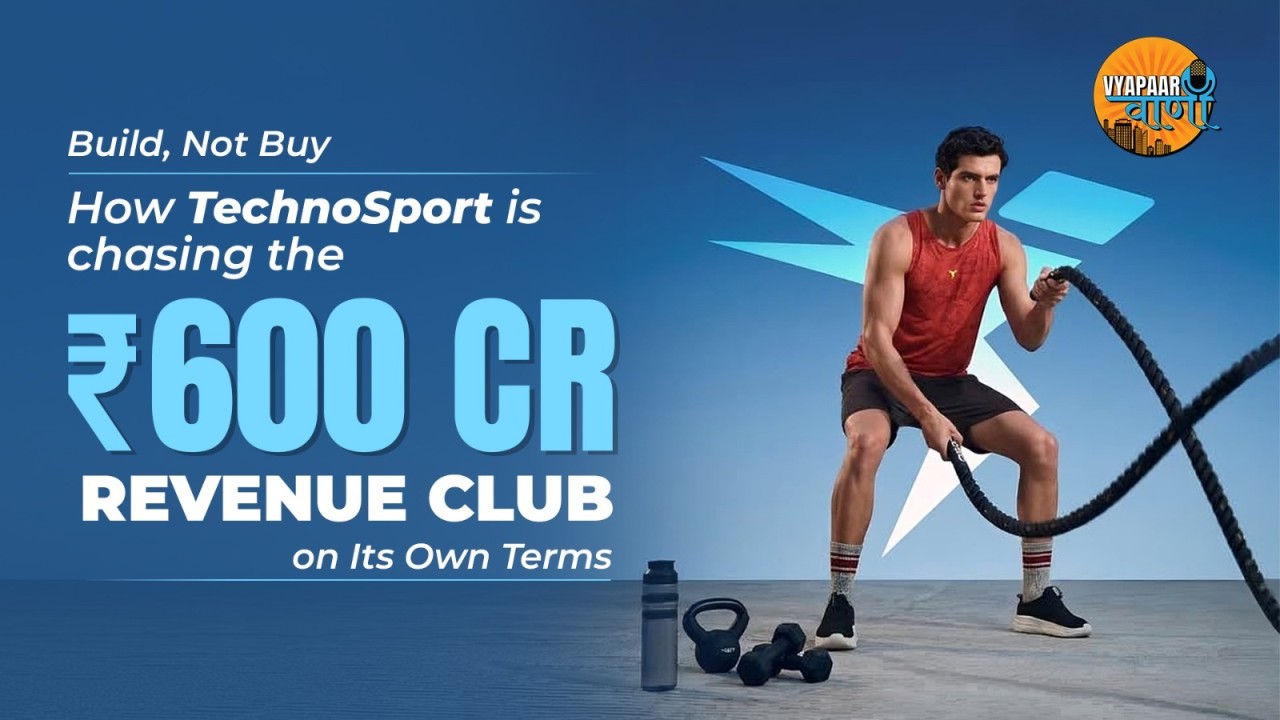
Build, Not Buy: How TechnoSport Is Chasing the ₹600 Cr
Revenue Club on Its Own Terms
This Week's Highlights
5 Top Manufacturing Startups To Watch

How Flo Mobility Is Bringing AI-Powered Robots to India's Construction Sites

Bad Skin Day Billion Dollar Idea: The Yes Madam Story

How Frostreats Turned A Simple Idea Into ₹14 Crore Business

Secures ₹290 Crore Series B To Scale Rural Retail Network

How Pilgrim Achieved 24x Growth In The Beauty Industry?
What began as gym wear evolved into athleisure, then became a full-blown lifestyle category. Today, the global activewear industry is worth $373 Bn and is growing at nearly 9% annually. India's share of that story is just getting started, with the domestic market projected to grow at 11.8% a year to hit $41.2 Mn by 2033.
But here is the problem nobody talks about enough. For years, India's activewear market has been structurally broken. Global brands dominated with imported, expensive products. Domestic players lacked the technical depth to build performance fabrics at scale. And the raw materials needed to make quality activewear? Largely imported, adding currency risk, longer lead times, and ballooning costs to an already fragile supply chain.
TechnoSport, founded in 2007, decided to solve the problem from the inside out.
The Founding Bet: Build the Infrastructure, Not Just the Brand
When TechnoSport entered the market, global brands were doubling down on India. Their playbook was predictable: import premium products, build aspirational brand value, and target affluent urban consumers.
TechnoSport took the opposite road entirely.
Instead of chasing brand cachet, the company focused on building manufacturing capability. The founding philosophy was straightforward: build in India, build for India. That meant localising the most complex and expensive part of the value chain, which is fabric development, at a time when almost no one in India was doing it.
In the early years, that required bootstrapping capabilities that simply did not exist locally. The company collaborated with international partners in Taiwan and Canada, importing specialised yarn while developing in-house expertise in knitting and processing. Over time, this hybrid model helped reduce import dependence and laid the foundation for what TechnoSport would eventually become.
Today, the company controls nearly every stage of production: yarn processing, fabric engineering, dyeing, and finishing. Cutting and stitching remain distributed, but the highest value-add layer, which is the fabric itself, sits firmly within the company.
"This distinction is critical," says CEO Maity, who joined the company in 2022 with experience leading the CultSport and sportswear categories at Myntra. "In activewear, fabric determines performance. By owning this layer, we can innovate, iterate, and price more efficiently than competitors reliant on external suppliers."
Cracking the Price-Performance Equation
One of the most persistent myths in activewear is that performance must come at a premium. High-function fabrics that wick moisture, fight odour, and protect against UV rays are assumed to be out of reach for the average Indian consumer.
TechnoSport has been quietly dismantling that assumption.
Its fabrics are engineered to move sweat away from the body, disperse it across the surface, and accelerate evaporation. They contain anti-microbial compounds like Zinc Pyrithione to prevent odour-causing bacteria. They carry UPF 50+ UV protection, anti-static properties, and enhanced breathability, making them genuinely suited for India's demanding climate.
What makes this remarkable is not just the feature list, but the price tag. TechnoSport's average price point sits at ₹450 to ₹500 per garment, a fraction of what most global performance brands charge.
The math behind this is rooted in scale and integration. With production volumes running up to 3 lakh garments a day, fixed costs are spread thin across massive output. And because the company controls its own fabric development, it avoids the supplier margins that typically stack up across fragmented supply chains.
The result is a product that performs at a global standard while remaining accessible to a far wider section of Indian consumers.
Manufacturing as a Strategic Moat
While most direct-to-consumer brands have gravitated towards asset-light models, outsourcing production and focusing on branding, TechnoSport has deliberately gone in the opposite direction.
The company has invested ₹200 Cr in a manufacturing facility in Tiruppur, one of India's textile heartlands. The facility integrates knitting, dyeing, and finishing under one roof, reducing reliance on external vendors at every critical stage. It is powered by renewable energy and recycles approximately 95% of the water it consumes.
This level of integration has two distinct advantages.
First, it gives TechnoSport control over its cost structure. Since most of the value addition in activewear happens at the fabric stage, keeping that process in-house means retaining margins that would otherwise be distributed across multiple vendors.
Second, it improves speed and responsiveness. By digitising operations through IoT-enabled systems and real-time production monitoring, the company can better align manufacturing output with demand signals coming from distributors, marketplaces, and its own sales channels.
In that sense, the manufacturing investment is not just a cost play. It is an enabling layer that supports competitive pricing, supply reliability, and the ability to iterate on products faster than competitors.
The Pandemic Inflection Point
Nike's Chief Science Officer Matthew Nurse observed a clear shift over the past five years: consumers are no longer just working out, they are investing in their health more broadly. "Lots of new gyms are not just workouts, they're longevity centres," he noted.
For TechnoSport, the pandemic was the moment of validation.
As consumers shifted from occasional workouts to sustained lifestyle changes, activewear became habitual rather than purely functional. People wore it not just for exercise but as everyday clothing. TechnoSport's value proposition, affordable, functional, and comfortable, aligned perfectly with this shift.
The growth numbers reflect that alignment. From steady pre-pandemic expansion, the company clocked 70 to 90% growth in 2022. Critically, that growth was not just demand-led. It was enabled by supply readiness. When many competitors struggled with inventory and sourcing, TechnoSport's localised manufacturing allowed it to respond faster and more reliably.
In May 2024, the company raised $25 Mn (approximately ₹208 Cr) in its first external funding round from A91 Partners. The capital has been directed towards expanding manufacturing capacity and building out digital brand presence and marketing.
Rewiring Distribution for the Next Phase
For most of its journey, TechnoSport relied on general trade as its primary growth engine, building a retail network that today spans nearly 7,000 outlets across India. This gave the brand strong penetration in non-metro markets, where affordability and availability drive purchase decisions.
From 2022 onwards, the distribution strategy has evolved significantly.
Exclusive brand outlets are being added, not just as sales points but as spaces to control the consumer experience and showcase the full product range. Digital channels have expanded across Myntra, Amazon, Flipkart, and the company's own direct-to-consumer website. The move into quick commerce platforms reflects a further alignment with how Indian consumers are increasingly choosing to shop.
Behind all of this is a recognition that the consumer journey is no longer linear. Discovery, purchase, and repeat behaviour happen across multiple touchpoints, and the brand needs to show up across all of them.
The financial results of this journey are hard to ignore. From approximately ₹75 Cr in FY20, the company is now approaching ₹600 Cr in FY26, while remaining EBITDA-positive and having raised limited external capital until recently.
Vyapaarवाणी Takeaway : Vyapaar Vani Takeaway
TechnoSport's story is a case study in conviction. At a time when the playbook for consumer brands was to go asset-light, outsource production, and spend on marketing, this Bengaluru-based company made the harder, slower, and ultimately more defensible choice: own the factory, own the fabric, own the margin.
That decision has compounded over nearly two decades into a business that can make performance activewear at a price most Indians can actually afford.
As India's fitness culture deepens and activewear moves further into the mainstream, TechnoSport's model looks less like a contrarian bet and more like a blueprint. The challenge now is sustaining that balance, between quality, affordability, and scale, as the brand grows into its next chapter.
Stay tuned for more stories on India's most ambitious builders in Vyapaar वाणी!
Connect With Us
For Any Inquiries Or Assistance, Please Feel Free To Reach Out. Our Team Is Here To Support You And Will Respond At The Earliest Convenience