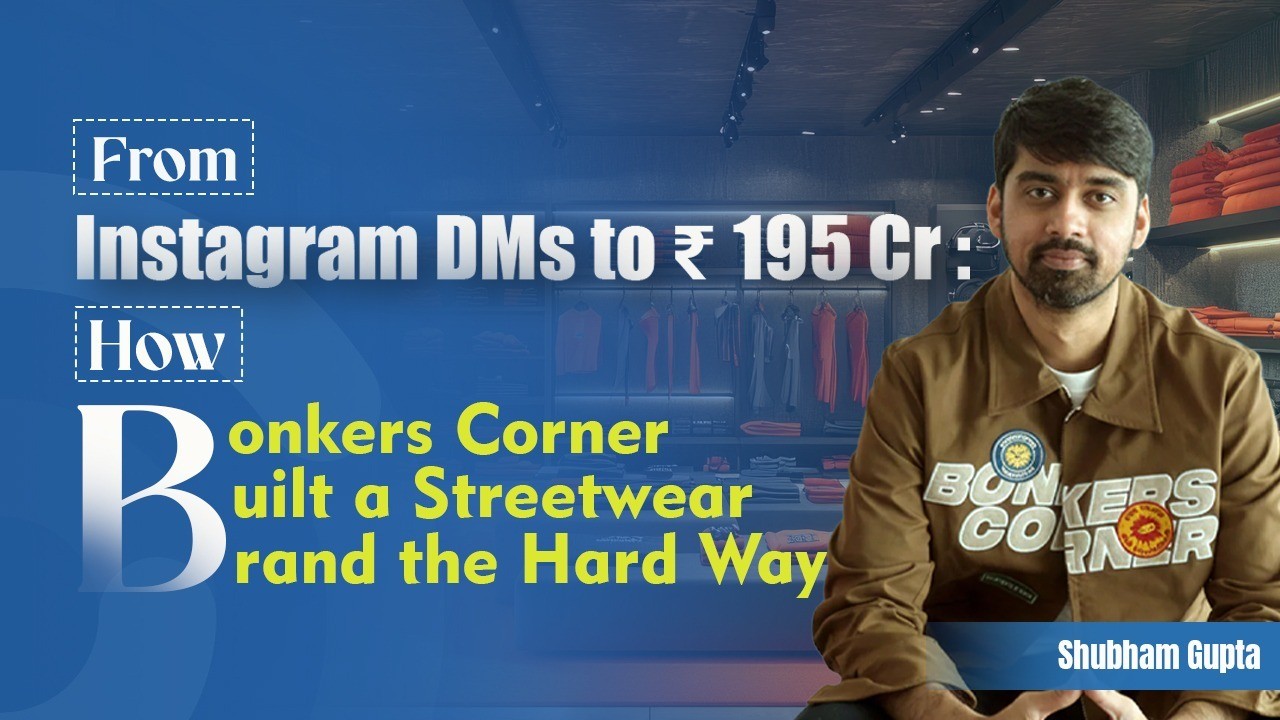
From Instagram DMs to ₹195 Cr: How Bonkers Corner Built
a Streetwear Brand the Hard Way
This Week's Highlights
5 Top Manufacturing Startups To Watch

How Flo Mobility Is Bringing AI-Powered Robots to India's Construction Sites

Bad Skin Day Billion Dollar Idea: The Yes Madam Story
How Frostreats Turned A Simple Idea Into ₹14 Crore Business

Secures ₹290 Crore Series B To Scale Rural Retail Network

How Pilgrim Achieved 24x Growth In The Beauty Industry?
Before there was a brand, a website, or even a team, there was a young man who had dropped out of college in 2011 to rescue his family's textile printing business. He spent the next nine years learning everything the industry does not teach in classrooms: how chemicals behave in printing processes, what goes wrong in production, how to source materials without getting misled, and how to build a garment from the ground up without intermediaries eating into the margin.
By 2020, when the pandemic brought the world to a standstill and his contract manufacturing business began to slow, Gupta faced a choice. Keep depending on other brands for work, or build something of his own.
He chose to go Bonkers.
Spotting the Gap Nobody Else Wanted
Oversized apparel was trending globally when the pandemic hit. Indian brands, however, were not paying attention. Gupta was.
He started simply: a few SKUs of oversized women's tees, mockups made in-house, promoted through Instagram ads, and orders taken through DMs. There was no team. No external capital. No safety net.
"When I started, I was working alone. Manufacturing was in-house and orders were primarily through Instagram DMs. There was no team and I didn't have any money. Our first designer was hired only a year later," Gupta recalls.
By the end of FY21, Bonkers Corner had crossed Rs 5 Cr in revenue. The foundation was set, and it had been built entirely on instinct, technical knowledge, and a trend that everyone else had chosen to ignore.
Building the Brand on Fundamentals
What sets Bonkers Corner apart from most D2C fashion brands is not the product alone. It is the founder's refusal to outsource the hard parts.
Gupta handles every stage of manufacturing directly, from material sourcing to supply chain. The company runs three manufacturing facilities and uses printing machinery from Portugal, stitching and embroidery machines from Japan, and raw materials including yarn sourced domestically from Vardhaman. Inks are imported from Japan.
"There's a clear difference between us and many other brands because I come from a technical background, having spent nearly nine years in production. I understand everything from sourcing and pricing to garment construction, so there's no scope for inefficiencies or being misled," Gupta says. Many founders rely on intermediaries for these decisions, which raises costs and reduces quality.
That hands-on control has kept the cost structure lean even as revenue has scaled. The company maintains a tight overhead, a small team relative to its size, and has never had to write off inventory, an almost unheard-of achievement in fashion retail where most brands absorb 5 to 10% write-offs as a routine cost of doing business.
The reason is an elegant one. When Gupta noticed that male buyers were gravitating toward products originally designed for women, he leaned into the unisex positioning rather than building separate lines. A single inventory could serve both segments regardless of the split.
Dead stock became a non-issue.
Growing the Portfolio
Bonkers Corner's product range today spans 12,000 SKUs across oversized apparel, gym wear, joggers, hoodies, and sweatshirts. Joggers, which became bestsellers early on, now account for 50% of revenue.
The brand also moved early into licensed collaborations with names like Disney, Smiley, Playboy, Tokidoki, and Hot Wheels. These partnerships now contribute 15% of total revenue and have helped position the brand at the intersection of streetwear and pop culture.
The influencer marketing strategy has been equally deliberate. In the early years, Bonkers spent 40 to 50% of its marketing budget on influencer collaborations, driving organic discovery among Gen Z audiences at a relatively low customer acquisition cost. As the brand scaled, the marketing mix evolved: today it allocates 30 to 35% to performance marketing on Meta and Google, 25 to 30% to influencer partnerships, and 15 to 20% to content and social.
Influencer marketing transitioned from a pure acquisition lever to a content and trust engine, while offline stores began acting both as visibility drivers and conversion hubs, Gupta explains.
Taking the Brand Offline
In 2023, Bonkers made its first foray into physical retail, beginning with a pop-up at Comic Con before opening its first permanent store at Phoenix Mall in September of that year.
The offline bet has paid off. Retail now contributes 40% of total revenue, with 55% coming from the brand's own website and the remaining 5% from marketplaces. The company is planning 25 to 30 new store launches this fiscal, with a target of 100 outlets by next year.
The brand also appeared on Shark Tank India Season 5, where Namita Thapar of Emcure Pharmaceuticals invested Rs 1.5 Cr. In March 2026, Bonkers closed a Rs 15 Mn Series A round led by India SME Investments, with participation from Atul Ruia-led Phoenix Family Office.
Headwinds and What Comes Next
The road ahead is not without friction. The ongoing conflict in West Asia has pushed raw material prices up sharply, with yarn and dye costs rising as much as 30%. Workers have been migrating back to their hometowns as rising LPG prices have made city living more expensive, creating labour shortages at Gupta's facilities.
"If the war goes on, I will have to change the pricing. As of now, I am absorbing the extra cost," he says.
With fresh capital in place, the company is pressing ahead on multiple fronts. A new green manufacturing plant is being built in Murbad, Maharashtra, designed to be fully sustainable and compliant.
Denim is the next category in focus for the ongoing fiscal.
Vyapaarवाणी Takeaway : Technical Knowledge Is an Unfair Advantage
Bonkers Corner's story is not a typical D2C founder journey. There was no venture backing, no co-founder with a finance background, and no shortcut through an MBA playbook.
What Gupta had instead was nine years of learning the most unglamorous parts of the fashion industry from the inside out. That knowledge, applied to building a brand rather than just a manufacturing business, became a genuine and durable competitive advantage.
In a category where most brands rely on intermediaries and suffer the costs of opacity, Bonkers kept control of its supply chain, its margins, and its quality. The result is a business that has been profitable since its very first year and is now on course for Rs 195 Cr in revenue with Rs 15 to 16 Cr in net profit.
For founders building in fashion or any product-led category, the lesson is simple. Understanding the craft behind the product is not optional. It is the moat.
Connect With Us
For Any Inquiries Or Assistance, Please Feel Free To Reach Out. Our Team Is Here To Support You And Will Respond At The Earliest Convenience