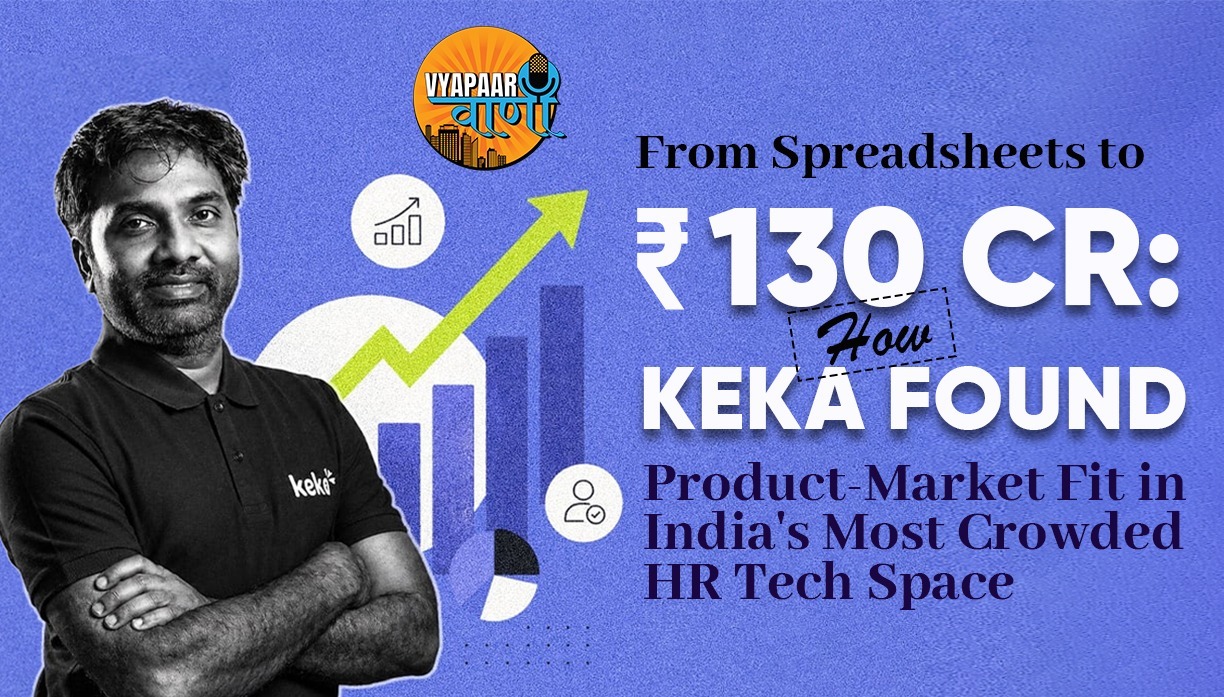
From Spreadsheets to ₹130 Cr: How Keka Found Product-Market Fit
in India's Most Crowded HR Tech Space
This Week's Highlights
5 Top Manufacturing Startups To Watch
How Flo Mobility Is Bringing AI-Powered Robots to India's Construction Sites

Bad Skin Day Billion Dollar Idea: The Yes Madam Story

How Frostreats Turned A Simple Idea Into ₹14 Crore Business

Secures ₹290 Crore Series B To Scale Rural Retail Network

How Pilgrim Achieved 24x Growth In The Beauty Industry?
In 2014, India's HR managers were having an identity crisis.
They wanted to be strategic business partners, shaping company culture and workforce strategy. Instead, most were confined to back-office administration: payroll runs, attendance tracking, leave approvals. The technology available to support anything beyond these basic functions was thin, fragmented, and largely unhelpful.
Vijay Yalamanchili was watching this closely. He saw an HR tech market crowded with point solutions, tools that handled payroll or attendance in isolation, but nothing that treated the employee lifecycle as a single connected system. His insight was simple but underappreciated at the time: hiring, onboarding, performance, payroll, and engagement were not separate problems. They were stages of the same workflow.
That insight became Keka, launched in 2016.
Finding Product-Market Fit in a Crowded Market
Keka's early traction came from an unexpected segment: fast-growing mid-market businesses in Tier II cities and emerging business hubs.
These companies were mobile-first and scaling rapidly across sectors, but they were still running their workforce operations through spreadsheets and fragmented manual processes. They were exactly the kind of businesses that needed an integrated platform but had been overlooked by HR software built primarily for large enterprises and compliance teams.
Yalamanchili's core thesis was straightforward: instead of building isolated tools for payroll, attendance, leave, performance, and hiring, build a single connected platform where all of these workflows lived together. That integration became Keka's most durable competitive advantage in a market full of point solutions.
The pandemic became an unexpected accelerant. As remote work became mandatory overnight, enterprises that had relied on legacy, office-bound HR systems suddenly needed mobile-first platforms that could support the HR function from anywhere. Companies that had initially adopted Keka just for attendance or payroll began expanding into performance management, onboarding, hiring, and employee engagement.
"Usage across the organisation and retention were the clearest signals. When teams started relying on the product for core workflows, we knew we had strong product-market fit," Yalamanchili says.
That expansion pattern, starting narrow and growing into a full workforce platform, became the engine behind Keka's growth. Revenue stood at Rs 14.5 Cr in 2021. Following a $1.6 Mn institutional funding round that year, the company achieved 10x ARR growth, and in 2022 raised a $57 Mn Series A from WestBridge Capital. Today, Keka generates over Rs 130 Cr in revenue and serves more than 10,000 organisations globally.
The Strategic Bets That Shaped the Platform
Keka differentiated itself in two deliberate ways.
The first was who the product was actually built for. When Keka was incorporated, most HR tech platforms were designed primarily for administrators and compliance teams, the people managing the system rather than the people using it day to day. Keka built for everyone: employees, managers, HR teams, and finance departments all interacting with the same system regularly. That breadth of usage made the platform far stickier within organisations, since it became embedded into daily operations rather than just a back-office tool that HR alone touched.
The second was reframing the problem itself. Rather than positioning workforce operations as purely an HR concern, Keka positioned it as a business continuity issue. In sectors like healthcare and logistics, where shift scheduling, overtime calculations, and payroll accuracy directly affect operational efficiency, this reframing helped Keka move beyond being seen as just an HRMS provider and gain meaningful traction with larger enterprises.
Where AI Fits In
AI is Keka's next major focus, but the company has deliberately avoided launching it as a standalone product.
Instead, AI has been embedded directly into existing workflows. Keka Hire uses AI for automated job description creation, candidate screening, and interview question generation. Performance management includes AI-assisted goal setting. OKR recommendations are tailored by role.
The broader goal is to use AI to streamline candidate communication and surface workforce insights, improving decision-making and productivity within the workflows people already use rather than asking them to adopt something entirely new.
The Opportunity Ahead
Despite the competition from both Indian startups and global software companies expanding into payroll, hiring, employee engagement, and workforce management, Yalamanchili believes the Indian HR tech market remains significantly underpenetrated.
More than half of Indian businesses still do not use a formal HR system. That gap represents a substantial opportunity for workforce digitisation, one that Keka intends to keep capturing as it deepens its presence across India, the Middle East, and the US.
The company also sees rising opportunity in sectors where workforce complexity is increasing: healthcare, logistics, manufacturing, and professional services, all of which face the kind of scheduling, compliance, and operational challenges that an integrated platform is well suited to solve.
Vyapaarवाणी Takeaway : Integration Is a Strategy, Not Just a Feature
Keka's story is a clear demonstration of a principle that applies well beyond HR tech: in a market full of point solutions, the company that successfully integrates the entire workflow often wins, even against competitors with deeper pockets or more specialised individual features.
The decision to treat hiring, payroll, performance, and engagement as one connected system rather than four separate products was not just a product choice. It was a bet on how organisations actually function, and it turned out to be the right one.
As AI continues to reshape how businesses hire, manage, and engage talent, the question for Keka is whether the same integration-first philosophy that won it product-market fit in a crowded software category can carry it through the next wave of disruption. Given its track record so far, that bet looks reasonably well placed.
Stay tuned for more stories on India's most ambitious builders in Vyapaar वाणी!
Connect With Us
For Any Inquiries Or Assistance, Please Feel Free To Reach Out. Our Team Is Here To Support You And Will Respond At The Earliest Convenience