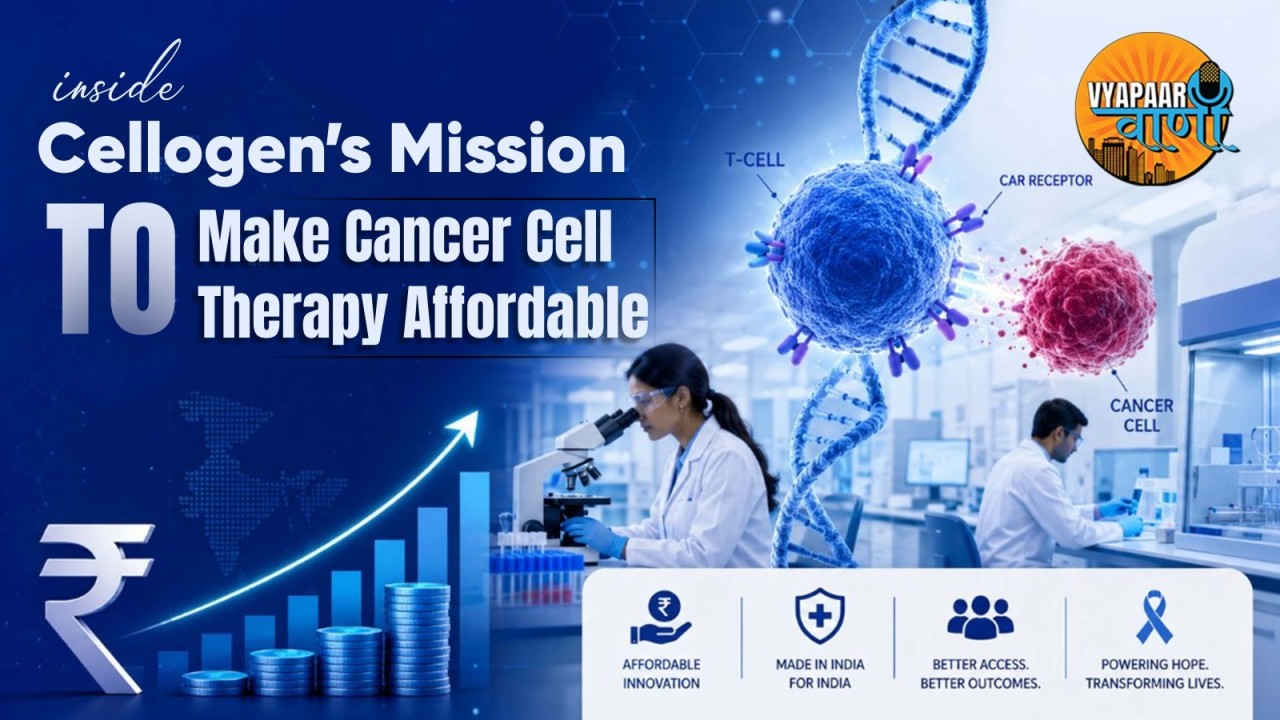
Inside Cellogen's Mission to Make Cancer Cell Therapy
Affordable
This Week's Highlights
5 Top Manufacturing Startups To Watch

How Flo Mobility Is Bringing AI-Powered Robots to India's Construction Sites

Bad Skin Day Billion Dollar Idea: The Yes Madam Story

How Frostreats Turned A Simple Idea Into ₹14 Crore Business

Secures ₹290 Crore Series B To Scale Rural Retail Network

How Pilgrim Achieved 24x Growth In The Beauty Industry?
When Dr Gaurav Kharya returned to India in 2014 after training at Newcastle and Imperial College London, he brought back more than medical expertise. He brought back a frustration that would take nearly a decade to resolve.
As a pediatric blood cancer specialist, he had spent years watching hospitals abroad offer cutting-edge cell and gene therapies as outright cures. In India, patients with the same diagnoses were making do with painkillers and basic chemotherapy. The science existed to do better. The access did not.
That gap, between what was possible and what was available, became the founding conviction behind Cellogen Therapeutics.
The Problem With Existing CAR-T Therapy
CAR-T therapy is one of the most significant advances in cancer treatment in decades. It works by taking a patient's own immune cells, re-engineering them in a laboratory to recognise and attack cancer cells, and infusing them back into the body.
The results, for certain blood cancers, have been remarkable. But the therapy has two persistent failure modes that limit its long-term effectiveness.
The first is antigen escape. Current second-generation CAR-T treatments for B-cell malignancies target a single protein marker called CD19. While they often work initially, cancer cells can learn to mask CD19 over time, effectively becoming invisible to the engineered immune cells. This drives 20 to 30% of relapses. Overall, roughly 50 to 60% of patients relapse within five years.
The second is persistence. Engineered T cells often fail to survive long enough in the body to provide lasting protection, leaving patients vulnerable to recurrence.
Cellogen's lead therapy, XenCAR-T, is designed to address both problems simultaneously.
What Cellogen Built Differently
XenCAR-T is a third-generation bispecific CAR-T therapy. Rather than targeting CD19 alone, it targets both CD19 and CD20. When cancer cells switch off one marker to evade detection, the second remains active and the engineered immune cells continue to hunt.
Underpinning the therapy is a patented lentiviral vector platform, an advanced gene delivery vehicle that helps produce engineered cells designed to survive longer in the body, hunting cancer for years rather than months.
Cellogen was co-founded by Dr Kharya and Dr Tanveer Ahmad, a researcher in cancer cell engineering. Together they have built a system where the most expensive and critical components of CAR-T manufacturing are produced in-house at their three specialised facilities in Noida.
The most expensive imported input in the industry, the lentiviral vector, is manufactured internally at roughly one-twentieth the cost of imports. Sixty to seventy percent of the quality-control kits required to clear each batch have also been developed in-house rather than imported at steep cost.
The result is a therapy that Cellogen is targeting to commercialise at approximately Rs 25 lakh per course, compared to a global price of $400,000 to $600,000, and a domestic benchmark set by ImmunoACT of Rs 30 to 35 lakh.
How AI Compressed a Two-Year Process Into 24 Hours
The traditional method of discovering antibodies for CAR-T therapies relies on technologies like hybridoma and phage display that are 40 to 50 years old. Developing a single new antibody this way takes approximately two years.
Cellogen has built two proprietary AI tools that have collapsed that timeline dramatically.
The first, CelAbGen, draws on roughly a million antibody sequences and structures from across species to generate entirely new antibodies in 24 hours. The second, CARMSeD, screens which of those generated antibodies will actually function as an effective CAR molecule, testing factors like structural complexity and binding reliability to the cancer target.
CARMSeD has already screened 10,842 CAR constructs. Molecules selected from that library are now heading into clinical trials.
Cellogen claims to have built the world's largest library of AI-generated CAR constructs at nearly 13,000, and is developing a third tool, a CAR-T AI Agent, as a knowledge platform for doctors, patients, and researchers globally.
Three Revenue Streams Before the First Therapy Reaches a Patient
Cellogen's deep investment in manufacturing and tools has produced an unexpected second business.
The lentiviral vector that Cellogen manufactures in-house, the same component that is a critical bottleneck for India's nascent cell and gene therapy ecosystem, is now being supplied to research institutions including IIT Kanpur, CMC Vellore, and the Indian Institute of Chemical Biology in Kolkata. Two to three production batches a month already generate Rs 30 to 40 lakh in revenue.
The indigenous quality-control kits developed for internal use are also being licensed out. And the AI tools are being readied as a SaaS-style platform.
That gives Cellogen three distinct revenue streams before XenCAR-T has treated a single patient, positioning the company as both a therapy developer and a picks-and-shovels supplier to the broader Indian cell and gene therapy ecosystem.
On the funding side, Cellogen raised Rs 18 Cr from Natco Pharma in January 2024, followed by Rs 20 Cr from Kotak Alternate Asset Managers in May, with Natco Pharma participating again with an additional Rs 2.5 Cr. The company has also pulled in over Rs 15 Cr in non-dilutive grants from BIRAC and other government schemes. XenCAR-T's first-in-human study will be conducted at CMC Vellore, with regulatory clearance expected imminently and commercialisation targeted within 18 to 24 months.
The Competitive Landscape
Globally, CAR-T therapy is dominated by Novartis, Gilead, Bristol Myers Squibb, and Johnson and Johnson. Their therapies remain largely inaccessible outside the US and Europe due to cost.
In India, the space is small but accelerating. ImmunoACT, the IIT Bombay spinout backed by Laurus Labs, launched India's first domestic CAR-T therapy in 2023 at roughly a tenth of the global price. Immuneel Therapeutics, co-founded by Kiran Mazumdar-Shaw, is close behind with its own CD19 candidate. Cellogen differentiates itself through the dual-targeting approach, the in-house manufacturing stack, and the AI tooling layer that none of its domestic competitors have yet built.
Vyapaarवाणी Takeaway : The Most Defensible Biotech Businesses Own Their Entire Stack
Cellogen's story carries a lesson that extends well beyond oncology. The company's decision to build its own lentiviral vector manufacturing, develop its own quality-control kits, and build its own AI discovery tools was not just a cost-reduction exercise. It was a strategic choice to own every layer of a value chain where dependence on imports had been treated as unavoidable.
That ownership is now generating revenue independently of the therapy pipeline, reducing the company's capital requirements, and creating a supplier relationship with the broader Indian biotech ecosystem that will persist regardless of how any single therapy performs in trials.
For founders building in deep science, the lesson is worth internalising: the infrastructure you build to serve your own needs often turns out to be the most valuable thing you have built.
The next 24 months, with clinical trials underway and commercialisation in sight, will determine whether Cellogen can deliver on its most important promise: a next-generation cancer therapy that patients in India and the developing world can actually afford.
Stay tuned for more stories on India's most ambitious builders in Vyapaar वाणी!
Connect With Us
For Any Inquiries Or Assistance, Please Feel Free To Reach Out. Our Team Is Here To Support You And Will Respond At The Earliest Convenience