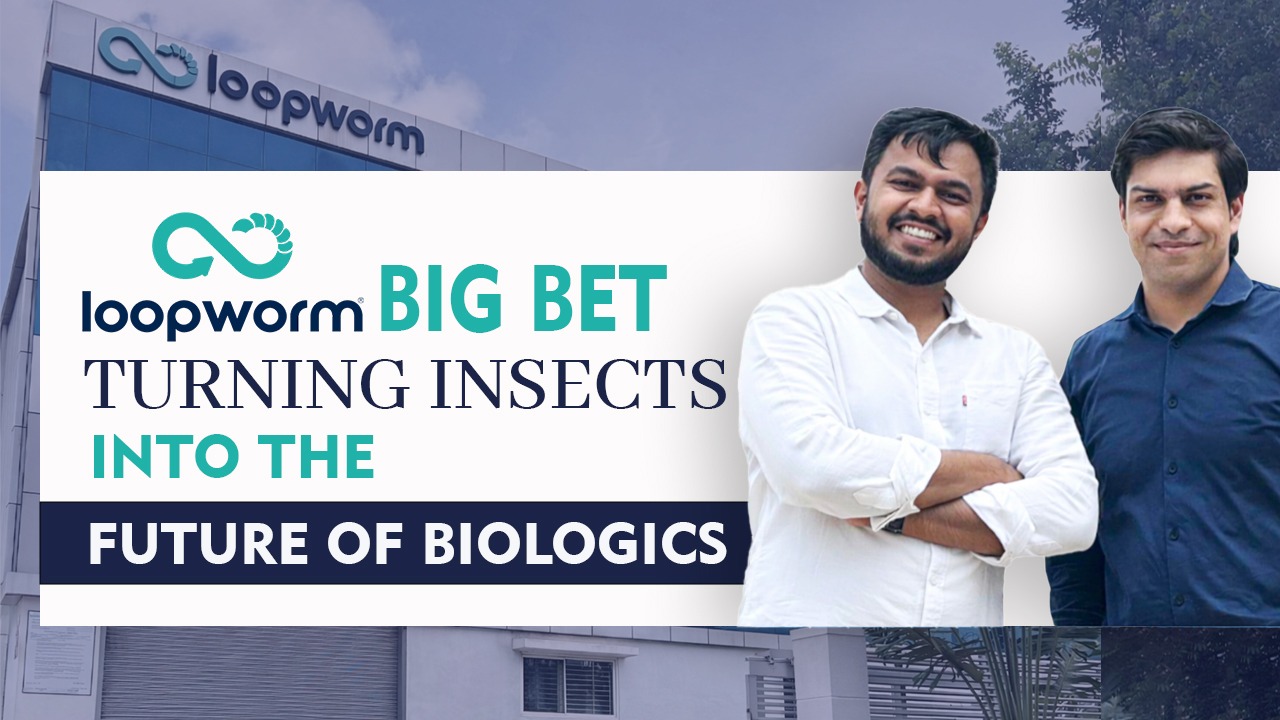
Loopworm's Big Bet: Turning Insects
into the Future of Biologics
This Week's Highlights
5 Top Manufacturing Startups To Watch

How Flo Mobility Is Bringing AI-Powered Robots to India's Construction Sites

Bad Skin Day Billion Dollar Idea: The Yes Madam Story

How Frostreats Turned A Simple Idea Into ₹14 Crore Business

Secures ₹290 Crore Series B To Scale Rural Retail Network

How Pilgrim Achieved 24x Growth In The Beauty Industry?
A blood test looks simple. Needle in, blood out. A vaccine feels routine. An over-the-counter pregnancy test takes minutes.
But behind each of these everyday medical interactions sits a complex class of molecules called protein biologics. They detect diseases, trigger immune responses, and treat conditions by interacting directly with the body's biological systems. Most of us encounter them regularly without ever knowing they exist.
Sourcing them, however, is anything but simple. They are expensive, technically difficult to manufacture, and the world depends on a small group of global producers to supply them. Complex biologics can cost over $500,000 a year per patient, putting them out of reach in many emerging markets where demand for diagnostics, research, and therapeutics is growing fast.
A Bengaluru startup decided to look for the answer in a very unexpected place: insects.
The Company and the Idea
Loopworm was founded in 2019 by Ankit Alok Bagaria and Abhi Gawri with a proposition that sounds unusual at first and increasingly logical the more you examine it. The company uses silkworms and black soldier flies to manufacture the same protein biologics that the medical and research world currently depends on large industrial bioreactors to produce.
The economics are striking. According to Bagaria, Loopworm can bring down the cost of manufacturing these proteins to anywhere between half and one-fifth of current costs, depending on the molecule and its complexity.
"Loopworm is not an animal nutrition company that happens to use insects. It is a manufacturing company that uses insects to make things the world needs," he says.
For now, the revenue engine runs on animal feed. Loopworm processes insects into high-protein concentrates and Omega-3-rich fats, sold as ingredients for aquaculture, poultry, and pet food. It supplies feed manufacturers across India and exports to companies in Japan, Europe, and South America. But the animal nutrition business, while operationally profitable and anchoring near-term growth, is a foundation. The larger ambition is biologics.
Finding the Opportunity in What Was Being Thrown Away
Bagaria came to Loopworm with the scar tissue of a previous failure. His first venture, AgroSnap, spent three years trying to build a crop leaf-imaging system to guide fertiliser use. It never quite worked. What it left him with was a sharper eye for where real value sits in agriculture.
When he and Gawri started working together in 2018, they set out to map which biological resources were abundant but underutilised. They landed on four categories: microorganisms, seaweed and algae, insects, and food industry byproducts.
India has a strong sericulture base, producing over 41,000 tonnes of raw silk in FY25. But the ecosystem had a blind spot. Silkworm pupae, a byproduct rich in protein and fat, were largely discarded. The entire industry was built around silk. The pupae were treated as waste.
Bagaria and Gawri saw the gap clearly. Take what was being thrown away, apply the right technology, and turn it into a high-value product the world actually needs.
Loopworm was incorporated in September 2019.
Building Something That Did Not Exist Yet
The early years were harder than the idea suggested. Building manufacturing facilities required capital the founders did not yet have, so they relied on grants to get started, including support from BIRAC's Biotechnology Ignition Grant, the Gates Foundation, Tata Trusts, and H&M Foundation, before raising an institutional round.
Convincing feed manufacturers to take a chance on silkworm protein was its own challenge. The product was unfamiliar. Buyers needed proof of consistent volumes, stable protein levels, and clean safety certifications before they would consider switching.
We had to think like a supplier and work backwards from what buyers actually cared about, Bagaria explains.
Export markets added another layer of friction. Japan and Europe had never encountered silkworm-based protein at scale. Most of the global insect protein industry had standardised around black soldier fly larvae. By choosing silkworms, Loopworm differentiated itself, but also took on the burden of building an entirely new category from scratch.
Today, Loopworm supplies shrimp feed manufacturers across Andhra Pradesh, Odisha, and West Bengal, works with aquaculture producers in Thailand, Vietnam, and Scandinavia, and sells into pet food companies across Europe.
How You Turn a Silkworm Into an Industrial Product
At a basic level, Loopworm treats silkworms as small biological production units. Silkworms are naturally efficient converters: they eat plant material and produce biomass that is rich in protein and lipids at a high rate.
The company has built processing systems that break down biomass, separate its components, and refine them into standardised protein powders and oils that can be stored, transported, and used reliably at industrial scale.
Bagaria compares it to oil refining. The raw input is messy and unusable in its original form, but once processed, it becomes a consistent, dependable industrial product.
"A large part of our effort goes into ensuring that what we produce is consistent enough for manufacturers to depend on," Bagaria says.
The Next Frontier: From Feed to Pharma
The animal nutrition business is profitable and growing, but for Loopworm's founders, it has always been a proof of concept for something bigger.
The company is now using silkworms to produce specialised proteins for diagnostic and research use, the same class of recombinant proteins that currently command premium prices from a handful of global biomanufacturers.
For FY26, the company is projecting revenue of Rs 15 to 18 Cr, nearly quadrupling its FY25 figure of Rs 4.5 Cr, driven by growing export demand for animal nutrition products and the early commercial push into recombinant proteins. The company has raised Rs 25.8 Cr from Omnivore Ventures in 2022 and a further Rs 27.8 Cr from Enrition Capital and Waterbridge Ventures in June 2025.
Loopworm is also conducting agricultural trials in collaboration with ICAR for a biostimulant product for crops, extending its technology into yet another adjacent area.
Vyapaarवाणी Takeaway : Turning Waste Into Value Is a Strategy, Not Just a Story
Loopworm's journey carries a lesson that applies far beyond biotechnology. The most durable business opportunities are often hiding in plain sight, in the byproducts, inefficiencies, and overlooked resources that existing industries have never bothered to examine.
Silkworm pupae were waste. The global biologics supply chain was expensive and concentrated. Indian tropical conditions were an untapped advantage. Loopworm connected those dots and built a business from the intersection.
The animal nutrition business proves the manufacturing model works. The recombinant protein ambition, if it scales, could be genuinely transformative for how emerging markets access critical medical inputs.
The broader question is not just about Loopworm. It is about whether insects can move from being an experimental input to a mainstream manufacturing layer. Loopworm is one of the few companies in the world seriously trying to find out.
Connect With Us
For Any Inquiries Or Assistance, Please Feel Free To Reach Out. Our Team Is Here To Support You And Will Respond At The Earliest Convenience