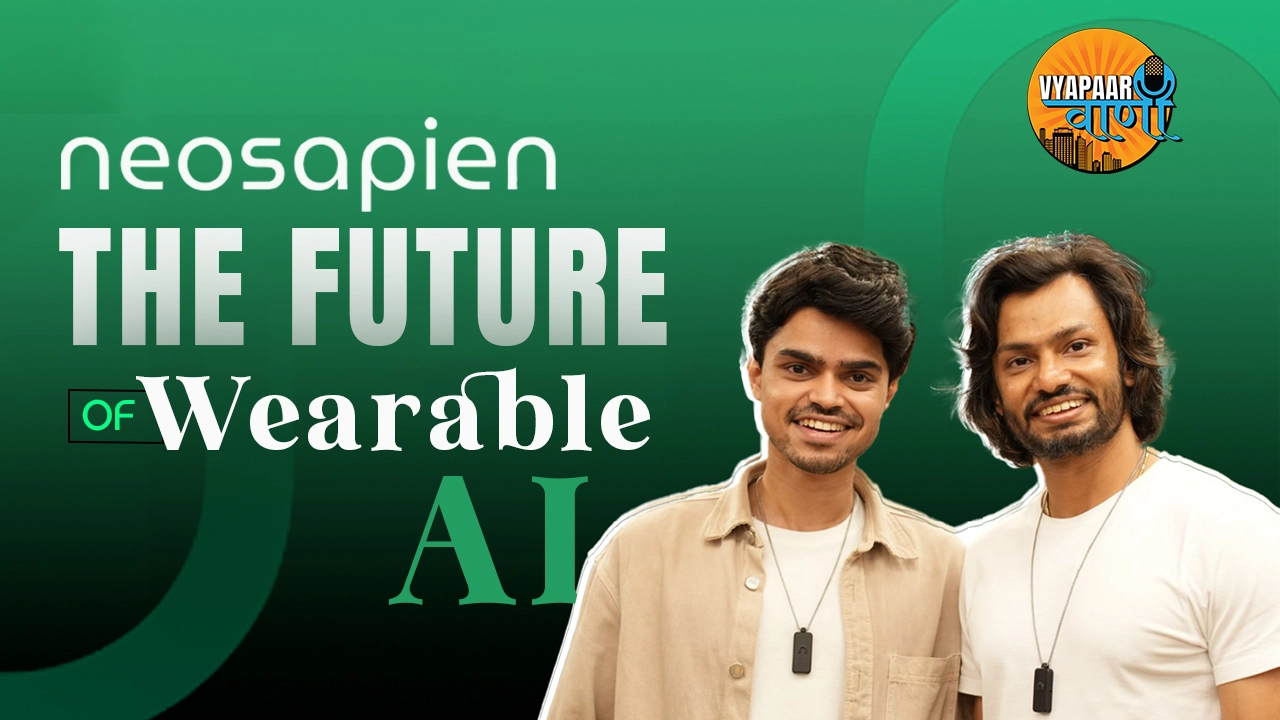
NeoSapien: The Future of
Wearable AI
This Week's Highlights
5 Top Manufacturing Startups To Watch
How Flo Mobility Is Bringing AI-Powered Robots to India's Construction Sites

Bad Skin Day Billion Dollar Idea: The Yes Madam Story

How Frostreats Turned A Simple Idea Into ₹14 Crore Business

Secures ₹290 Crore Series B To Scale Rural Retail Network

How Pilgrim Achieved 24x Growth In The Beauty Industry?
It hangs from a chain, pulsing softly with an LED light, and at first glance it looks like nothing more than a USB pen drive. But the technology packed inside this thumb-sized device listens to every conversation Dhananjay has, generates notes and transcripts, and sends reminders for every task he needs to follow up on.
This is Neo 1, India's first wearable AI assistant, built by Bengaluru-based startup NeoSapien. And it is quietly making the case that the next frontier of AI is not on your screen. It is on your body.
The Idea: A Real-Life Jarvis
Dhananjay Yadav is unusually candid about how he ended up as a founder.
"I always wanted to be a founding team member, but never a founder," he admits.
His career had taken him through Razorpay, ClearTax, Homelane, and eventually to European e-commerce giant Zalando's Berlin office. Then ChatGPT arrived. "It was magical," he says. "I was sure that Generative AI would soon be a revolutionary technology."
That conviction brought him back to Bengaluru and into conversation with his cousin Aryan Yadav, an IIT-Madras graduate with deep experience in Natural Language Processing. Together, they began thinking about what the next hardware era would look like.
"In every new era of technology, there is a change in the hardware form factor. We saw the rise of PCs, then laptops, then smartphones. Now, it is the age of AI," Dhananjay says.
Their reference point was not a product. It was a fictional character: Jarvis, Iron Man's AI assistant. The brothers wanted to build something that did not just respond to prompts but stayed connected to the user through every conversation, learning context continuously rather than in isolated interactions.
NeoSapien was founded in 2024. The Neo 1 launched in March 2025, followed by a Shark Tank India Season 4 appearance that put the product on the national radar. Earlier this year, the startup made headlines again when some of its products were allegedly stolen from its booth at the India AI Impact Summit 2026 during a security lockdown for Prime Minister Narendra Modi's visit.
Getting the First Yes
Before the funding rounds and the television appearances, the founding journey had a more scrappy beginning.
Early hardware glitches were ironed out, but finding capital proved harder. The founders took an unconventional route. They identified Araku, a café in Bengaluru popular with founders and investors, and began sitting there regularly to show off their prototype to whoever would look.
"Some people found it interesting and tweeted about it, which generated virality," Dhananjay recalls. That word-of-mouth eventually led to the first cheque into the company, from boAt co-founder Sameer Mehta.
The startup has since raised $2 Mn in a seed funding round backed by venture capital firm Merak Ventures, along with angel investors including Anupam Mittal of Shaadi.com, Emcure Pharmaceuticals' Namita Thapar, Pixxel's Awais Ahmed, and former Koo CEO Aprameya Radhakrishna.
What Neo 1 Actually Does
Neo 1 is worn around the neck and connects to a companion app on your phone. When active, its LED pulses to indicate it is listening. At any point, the user can save a memory through the app, triggering the device to process the audio and generate detailed meeting notes, a conversation recap, and a chatbot that can be queried for further details.
Action items are automatically generated and can be added to the user's calendar as reminders. The full verbatim transcript is also available, though no audio recordings are stored on the device.
The operating system powering Neo 1, called Neo OS, is built on patented technology that combines closed and open-source AI models with a proprietary knowledge graph. Over time, the system learns the user's preferences and patterns, making its outputs more personalised.
Language support is another standout feature. NeoSapien claims Neo 1 supports over 40 Indic languages and more than 100 global languages, a deliberate design choice for a market as linguistically diverse as India.
The device is priced at approximately Rs 10,000. All data is processed and stored on the company's cloud servers, encrypted, and not shared with third parties, with the company claiming compliance with applicable data privacy regulations.
Learning from a Category That Has Already Failed Once
The global AI wearables market is worth $23.56 Bn and is growing at 17.6% annually, on course to reach $303.59 Bn by 2035. But the category has a bruised reputation.
Humane's AI Pin, priced at $699, was widely panned for frequent malfunctions and shut down shortly after its flaws became public. Avi Schiffman's startup Friend, which positioned its wearable as a companion device, barely sold 3,500 units after its marketing provoked a backlash from consumers who rejected the idea of replacing human connection with AI.
NeoSapien has been careful to learn from both failures.
Rather than positioning Neo 1 as a companion or a lifestyle statement, the company has kept its use case clear and practical: a productivity tool for people who have a lot of conversations they need to track. Its initial target customer was the traditional MSME entrepreneur, think wholesale merchants and real estate owners, for whom meetings, calls, and follow-ups are the backbone of the business.
"For them, calendarised conversation, calls, and in-person meetings are critical," Dhananjay explains. That focused positioning also helped drive word-of-mouth in tightly networked industries where trust travels fast.
The company says it has no direct competitors in India yet, counting Meta's Ray-Ban AI glasses as the closest international equivalent rather than a local rival.
The Platform Vision: Beyond a Single Product
NeoSapien is not thinking of itself purely as a hardware company.
The longer-term ambition is to become a vertically integrated platform for AI wearables, licensing Neo OS to other companies so they can build their own devices on top of its software layer. Dhananjay draws a direct comparison to how Android works: "Google Pixel always gets the latest Android features, but Samsung phones also run Android. We want to open up Neo OS the same way. We want 500 Mn Indian users on our platform and 20 Mn on our devices."
An upgraded Neo 2 is planned for next year, with the same form factor but more advanced capabilities, including what Dhananjay describes as "agentic use cases." Expansion into the UAE and the US markets is also being considered.
Despite the growth plans, NeoSapien intends to stay lean. The current 13-member team may grow to 20 at most. Dhananjay cites AI-native startups like Lovable and Anysphere, the maker of Cursor, as proof that significant scale does not require large headcounts.
The ultimate aspiration, though, is something bigger than any single product.
"One day, we want to have Neo Con, an event where we unveil new features and devices that will be the first of this scale in India, on par with Google IO or any Apple launch event," Dhananjay says.
It is an ambitious dream. But then again, so was building India's first AI wearable out of a café in Bengaluru.
Vyapaarवाणी Takeaway : Vyapaar Vani Takeaway
NeoSapien's story carries a lesson that is easy to overlook: being early is not enough. The AI wearables category has already produced high-profile failures from well-funded companies. What separates NeoSapien is not just its technology but its restraint, a clear use case, a focused customer, a practical price point, and a deliberate effort to avoid the traps that sank its predecessors.
India's AI adoption is accelerating fast, with 62% of workers already using GenAI tools at work and a middle class on course to hit 1 Bn by 2047. The demand for intelligent, affordable, ambient technology is only going to grow.
Whether NeoSapien can scale from thousands of units a month to the kind of platform it envisions will depend on how well it maintains that discipline as the market gets more crowded. For now, it has done something harder than it looks: it has made a genuinely new category of product feel sensible.
Stay tuned for more stories on India's boldest builders in Vyapaar वाणी!
Connect With Us
For Any Inquiries Or Assistance, Please Feel Free To Reach Out. Our Team Is Here To Support You And Will Respond At The Earliest Convenience