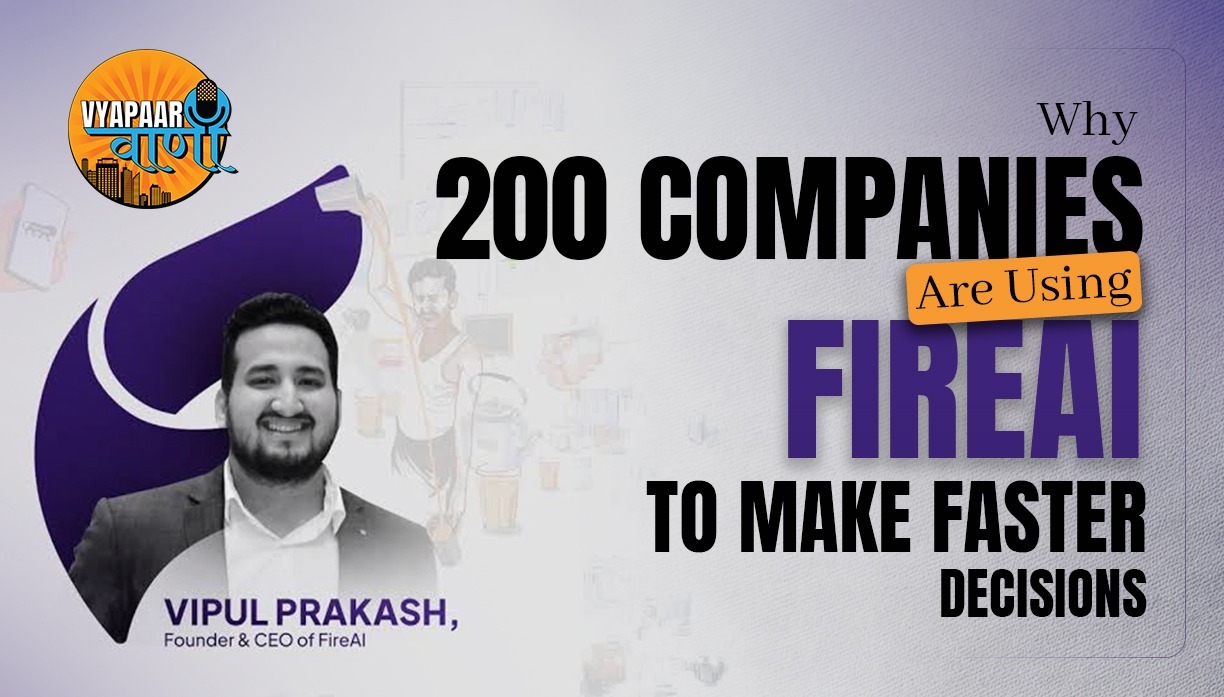
Why 200 Companies Are Using FireAI
to Make Faster Decisions
This Week's Highlights

5 Top Manufacturing Startups To Watch

How Flo Mobility Is Bringing AI-Powered Robots to India's Construction Sites

Bad Skin Day Billion Dollar Idea: The Yes Madam Story

How Frostreats Turned A Simple Idea Into ₹14 Crore Business

Secures ₹290 Crore Series B To Scale Rural Retail Network

How Pilgrim Achieved 24x Growth In The Beauty Industry?
Every enterprise has more data than it knows what to do with.
Sales figures, inventory levels, pricing data, footfall numbers, seasonal demand patterns: the information exists. It just lives in different systems, owned by different teams, formatted in different ways, and requiring a specialist analyst and several days of work before it can tell anyone anything useful.
For Bata, this meant that when sales started declining, understanding why required weeks of investigation across disconnected datasets. FireAI brought those datasets together, traced the decline through a causal chain, and surfaced the underlying factors in minutes.
For IRCTC, AI cameras were already monitoring kitchens around the clock, logging every safety violation. But each alert was an isolated event. No one could see patterns across locations or automatically route issues to the right kitchen manager. FireAI turned those disconnected alerts into a single intelligence layer.
For D2C beauty brand Plum, the platform improved net revenue realisation by around 12% and cut reporting time from more than eight hours to under two minutes by automating data reconciliation across marketplaces.
These are not demos. They are the problems that led Vipul Prakash to found FireAI in 2024 and the proof points that have helped the company reach Rs 9 Cr in annual recurring revenue within its first year of commercial operations.
The Frustration That Built the Company
Prakash's path to FireAI was not through foundation models or AI research. It came from years of running businesses and watching the same problem repeat itself across every industry he touched.
After graduating in electrical and electronics engineering in 2014, he worked at Zomato and BharatPe before joining his family's pharmaceutical business. In every role, the pattern was the same. Companies generated enormous amounts of data. Turning that data into decisions still required spreadsheets, delayed reports, and specialist analysts who took days to produce answers that were already outdated by the time they arrived.
The problem became most concrete when he joined the family business. Products would run out in one market while inventory sat idle in another, because sales, distributor, and warehouse data lived in entirely separate systems that never talked to each other.
That experience became FireAI's founding thesis.
Before writing a single line of production code, the founding team spent nearly five months speaking to businesses across sectors, validating pain points, and collecting enterprise datasets. Commercial operations began in November 2025 after multiple iterations with early customers. According to the company, nearly every major product feature came directly from customer feedback rather than an internal roadmap.
From Dashboards to Decisions
FireAI describes itself as a decision intelligence platform. The distinction matters.
Most business intelligence tools tell you what happened. A dashboard shows revenue is down. A report shows inventory is piling up. But explaining why it happened and suggesting what to do next requires a separate analyst, a separate process, and a separate set of tools.
FireAI is designed to close that gap. During a live demonstration, Prakash asked the platform why a company's sales were declining. Within seconds, the system traced the drop to its underlying business drivers, identified that nearly 40% of the decline came from a specific customer account, and generated a forecast of how the business could perform going forward.
Technically, the platform connects data across 700 or more sources, including ERPs, accounting software, CRMs, cloud databases, and marketing platforms. It creates a unified semantic layer without moving customer data outside their infrastructure, reading only database schemas and table structures rather than extracting complete datasets. SQL queries are generated directly against the customer's own databases, enabling real-time analysis while keeping data within the customer's environment.
The process works through a multi-agent architecture that sits before the language model. Specialised AI agents do the groundwork first: identifying relevant tables and fields, interpreting business context, mapping relationships between schemas, and defining the right formulas. Only after this preparation does the LLM generate SQL queries.
Under the hood, FireAI uses a fine-tuned version of Llama 3.3 for text-to-SQL generation, though the platform is model-agnostic and allows enterprises to integrate their own preferred models.
The Business Behind the Technology
FireAI's multi-agent architecture reduces token consumption significantly because only structured context reaches the LLM. This allows the company to price through subscriptions rather than usage-based token billing, maintaining gross margins of around 80 to 85%.
The company also charges an upfront integration fee to connect enterprise data infrastructure, creating a two-part revenue model: integration fees to get started and recurring subscriptions for ongoing use.
The current client base includes 200 customers, with enterprises accounting for roughly 60% of revenue and MSMEs the remaining 40%. Beyond Bata and IRCTC, clients include Central Warehousing Corporation and a growing roster of mid-market businesses across manufacturing, logistics, and retail.
The Road Ahead and the Challenges That Come With It
FireAI's early traction is real, but the path from Rs 9 Cr ARR to a scaled enterprise business is not straightforward.
Enterprise data remains fragmented. Many organisations still run on legacy ERPs, custom integrations, and siloed databases. Zero-friction onboarding is harder in practice than in the marketing promise, and it can take significant time before the platform's full value becomes visible to a customer.
Competition is intensifying. Global cloud providers are building more AI into their analytics stacks. Traditional business intelligence vendors are adding conversational features on top of existing dashboards. FireAI's task is to convince customers that it is not just another analytics tool, but a genuinely different way of working with data.
Enterprise sales cycles are long, management risk is real, and questions around control, accuracy, and data security are standard objections that every enterprise AI company has to work through carefully.
Despite these challenges, the direction of travel in enterprise technology is clear. The conversation is shifting from generating insights to enabling decisions. FireAI is betting that the real opportunity lies not in replacing business intelligence platforms but in building a reasoning layer on top of them.
Vyapaarवाणी Takeaway : Vyapaar वाणी Takeaway: The Most Valuable Enterprise AI Is the Kind That Tells You What to Do, Not Just What Happened
Business intelligence has existed for decades. Dashboards, reports, and analytics platforms have given companies more visibility into their own operations than ever before.
And yet, most enterprises still struggle to translate that visibility into timely, confident decisions. The gap between data and action remains wide, filled by analysts, spreadsheets, and the kind of manual work that takes days and produces answers that are already stale.
FireAI is betting that AI can finally close that gap, not by replacing the data infrastructure that enterprises have already built, but by adding a reasoning layer on top of it that can explain causality, surface root causes, and suggest next steps in minutes rather than days.
The business case is straightforward. The execution is what will determine whether FireAI becomes a new category or another feature in a larger platform. With Rs 9 Cr in ARR from 200 clients in its first year of commercial operations, the early evidence is promising.
Stay tuned for more stories on India's most ambitious builders in Vyapaar वाणी!
Connect With Us
For Any Inquiries Or Assistance, Please Feel Free To Reach Out. Our Team Is Here To Support You And Will Respond At The Earliest Convenience