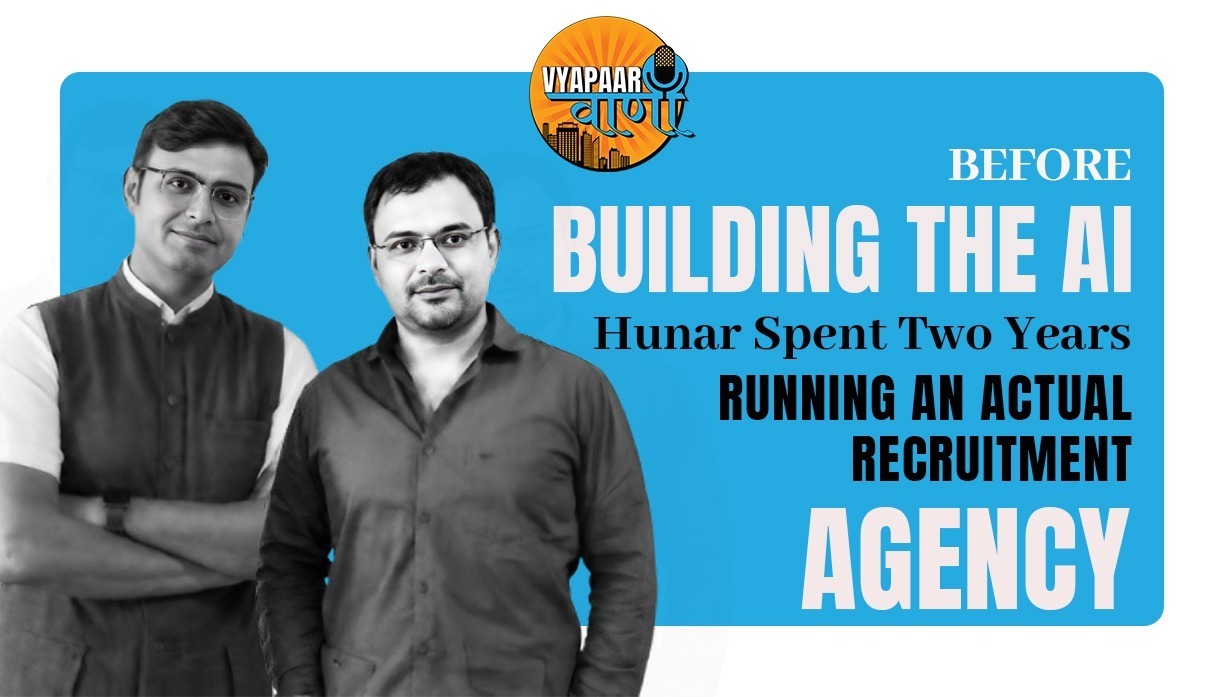
Before Building the AI, Hunar Spent Two Years Running an Actual Recruitment Agency.
Here Is What It Learned.
This Week's Highlights
How Vobiz.ai Is Powering the Next Generation of AI Voice Calls
5 Top Manufacturing Startups To Watch
How Flo Mobility Is Bringing AI-Powered Robots to India's Construction Sites

Bad Skin Day Billion Dollar Idea: The Yes Madam Story

How Frostreats Turned A Simple Idea Into ₹14 Crore Business

How Pilgrim Achieved 24x Growth In The Beauty Industry?
India's AI conversation is moving fast. Software agents, enterprise copilots, automation stacks for knowledge workers: the investment and the attention are flowing in one direction.
Meanwhile, one of the largest workforce segments in the country remains almost entirely untouched.
India's frontline workers, the delivery partners, retail staff, sales executives, construction workers, and gig economy operators who keep the economy running, face a different set of problems entirely. Attrition is high. Onboarding is fragmented. Training happens inconsistently. Most workforce communication still runs through manual phone calls made by human recruiters and HR staff working at a pace that simply cannot scale with the volume of workers being hired.
Bengaluru-based Hunar.AI was founded in 2022 by Krishna Khandelwal and Shantanu Bhattacharyya to solve exactly this problem. But before writing a single line of AI code, the founders did something unusual. They ran an actual recruitment agency.
Two Years on the Ground Before Building the Product
For nearly two years, Hunar.AI operated as a recruitment agency handling frontline hiring for enterprises. The founders wanted to understand, at ground level, how hiring conversations actually happened, why attrition remained stubbornly high, and where communication broke down between employers and workers.
During that period, the team recorded approximately 40 to 50 lakh minutes of workforce-related conversations: recruitment calls, onboarding interactions, assessment conversations, and retention discussions. That dataset eventually became the foundation of the company's conversational AI stack.
The insight that emerged from all those calls was specific. Most voice AI deployments in India focus on low-intelligence transactional use cases: EMI reminders, payment notifications, calls that last under 30 seconds and rely on standard speech-to-text systems. These are solved problems.
Frontline hiring conversations are a different challenge entirely. Screening a candidate, conducting an assessment, walking a new employee through onboarding, or identifying early attrition signals requires longer, contextual conversations where tone, pauses, interruptions, and speech patterns carry meaning alongside the words themselves.
Hunar.AI formally pivoted into voice-native AI infrastructure in 2024, after real-time audio models from companies like OpenAI became commercially viable.
Today, the platform powers more than 5 lakh calls daily and counts Swiggy, Zepto, Aditya Birla Capital, Bajaj Finserv, Croma, Dr Lal PathLabs, 1mg, and Starbucks among its customers. The company claims an average call duration exceeding three minutes, significantly higher than typical Indian voice AI deployments.
Why India's Frontline Hiring Needs Different AI Infrastructure
The standard voice AI pipeline works like this: speech is converted to text, an LLM processes the text, and the response is converted back to speech. For simple, transactional calls in controlled environments, this works reasonably well.
For frontline hiring conversations happening across small towns, logistics hubs, warehouses, and retail stores, it breaks down quickly.
Accents vary heavily by region. Background noise is unpredictable. Workers frequently use filler words or interrupt mid-sentence. Languages switch between regional dialects. Standard STT and TTS systems were not built for this environment.
Hunar.AI's response was to build what it calls a hybrid voice architecture. Rather than converting speech to text immediately, the system first processes raw audio through a proprietary layer called the Dynamic Config Generator. This filters out irrelevant acknowledgements, detects contextual pauses, and identifies language-specific filler words before any relevant signals reach the inference engine.
The architecture also preserves voice properties like tonality, speed, interruptions, and voice modulation, which carry important signals in hiring and assessment conversations where intent is often reflected through delivery rather than just the words chosen.
For interruptions, which are common in natural conversation, the company has built an Audio Regenerative Model that reconstructs conversational context in real time rather than restarting the interaction from scratch.
On multilingual support, Hunar.AI dynamically switches between text-to-speech providers including ElevenLabs and Cartesia depending on regional language performance. The company says this has driven particularly strong adoption across South India for Telugu, Kannada, and Tamil workflows.
From Recruitment Tool to Autonomous Workforce Platform
Hunar.AI's AI agents handle the full spectrum of frontline workforce management: candidate screening, assessments, interview scheduling, onboarding workflows, employee training, retention signal monitoring, and workforce engagement surveys.
The company positions this less as a generic voice AI platform and more as a set of specialised agents built around specific HR functions. The analogy Khandelwal uses is instructive: "On day zero, a recruiter and telecaller might not be different. But on day 30, they become massively different."
The platform operates across six sectors: quick commerce and e-commerce, supply chain and logistics, retail and quick service restaurants, healthcare diagnostics, banking and financial services, and construction and manufacturing.
Pricing reflects the function-based positioning rather than raw infrastructure usage. Screening calls are priced at Rs 15 to Rs 20 per call. Assessments and onboarding workflows range from Rs 75 to Rs 100. Enterprises pay for operational outcomes rather than voice minutes.
The company currently operates at an ARR of $3 Mn to $4 Mn. A funding round is in the process of being closed, with details to be announced formally.
The Data Advantage Being Built Over Time
Under the hood, Hunar.AI currently relies on models from Google and OpenAI, while experimenting with open-source models trained on its proprietary workforce conversation data.
The company stores millions of minutes of multilingual workforce interactions every month. Over time, the founders believe this accumulating dataset will allow them to train specialised models tailored specifically to Indian frontline workforce communication patterns, reducing dependence on third-party inference models and building a data moat that would be difficult for newer entrants to replicate.
Vyapaarवाणी Takeaway : The Best AI Products Are Built by People Who Did the Work Manually First
Hunar.AI's decision to spend two years running an actual recruitment agency before building AI is the most important strategic choice in this story, and the one most worth examining.
It is tempting to move fast in AI, to build the product first and learn from user data later. But in complex, human-intensive domains like frontline hiring, the nuance is in the details: the way a candidate hesitates before answering, the regional filler words that signal confusion, the moment in an onboarding call where attention drifts. These are things that show up in 40 to 50 lakh minutes of real conversations but would not show up in a product built from first principles alone.
That ground-level understanding is what gives Hunar.AI's infrastructure its specificity, and specificity in AI infrastructure is a genuine competitive moat.
For founders building AI products in complex, human-driven domains, the lesson is worth sitting with: the manual version of the problem is not the thing to skip. It is often the most valuable research you can do.
Stay tuned for more stories on India's most ambitious builders in Vyapaar वाणी!
Connect With Us
For Any Inquiries Or Assistance, Please Feel Free To Reach Out. Our Team Is Here To Support You And Will Respond At The Earliest Convenience